
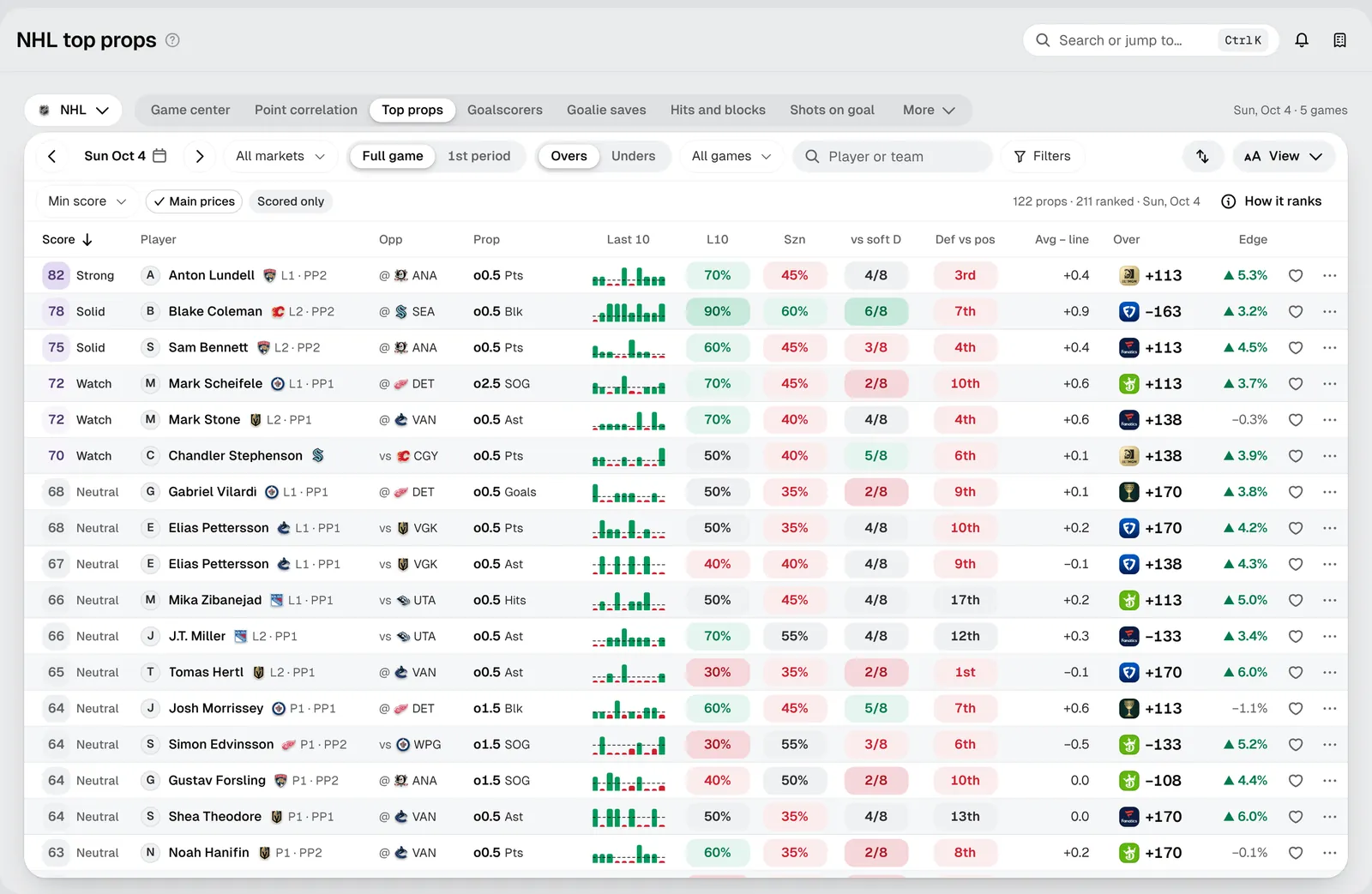
Open NHL Top props. Top props scores every NHL player prop posted for the slate, full game and 1st period, from 0 to 100, and lists them best first. It covers points, goals, assists, shots on goal, hits, blocks and goalie saves in one place, so it's the best first stop when you don't know where to start.
What the score means
Each prop's score blends four things:
| Part | Weight | What it measures |
|---|---|---|
| Hit rate | 35% | How often the player cleared this line in the last 10 games. |
| Matchup | 25% | How tonight's defense ranks against the player's position (or, for a goalie, how many shots the opponent takes). |
| Price | 25% | How the best price compares with a fair price worked out from the whole market. |
| Game | 15% | The game environment: how many goals the books expect the player's team to score. |
Scores sort into tiers: Elite (90+), Prime (85–89), Strong (80–84), Solid (75–79), Watch (70–74), Neutral (60–69) and Low (under 60). Press How it ranks for the full rules.
A score is a research summary, not a win chance. Use it to decide which props to look at first.
Reading a row
- Score: the number and its tier.
- Player: name, team and deployment: L1 · PP1 is first line, first power-play unit. Defensemen show their pair (P1).
- Opp: tonight's opponent ("@" away, "vs" home).
- Prop: the line, read line first. o2.5 SOG is over 2.5 shots on goal.
- Last 10: a bar per game, oldest left, against the line.
- L10 and Szn: how often the player went over in the last 10 games and this season.
- vs soft D: how often they went over against the softest third of the league's defenses.
- Def vs pos: tonight's defense against the player's position, from 1st (toughest) to 32nd (softest).
- Avg – line: the recent average minus the line.
- Over (or Under): the best price and its book.
- Edge: the expected value of that price against the fair price from the whole market. ▲ 5.3% means it pays about 5% more than fair. Hover it for the details.
Your first five minutes
- Pick the slate. The date arrows step through days.
- Pick the market. All markets opens a list: points, goals, assists, shots, hits, blocks, saves.
- Full game or 1st period. 1st-period props are scored on their own board.
- Overs or Unders. NHL books post both, so you can rank either side.
- Narrow it. All games, the search box, Min score, Main prices (hide alternate lines) and Scored only all trim the list. Filters holds the rest.
- Open a row. Click any row for the score's breakdown, the player's games and every book's price. The heart saves it to My Plays.
Tips for newer bettors
- Low lines, short prices. Many hockey props are 0.5 lines (one point, one assist). A 70% hit rate at -200 isn't the same as 70% at +110. Check the Edge column.
- The goalie matters. For goals and points, a backup goalie in the other net is a real boost. Check Goalie saves for who is projected.
- Deployment beats form. A player just moved onto PP1 may not show it in the last 10 yet. See Deployment radar.
Troubleshooting
- Few or no props: books may not have posted lines yet. Check closer to puck drop, or step to another date.
- A player is missing: check market, period, side, game, search, Min score and Scored only. Clear all resets.
- No Edge on a row: an edge needs both an over and an under price. One-sided markets show none.
Plan availability: Top props needs Scout. A free account sees the top 5 props in full and the next ten locked. See plans.