
Sharp Money reads the resting orders on two prediction markets, Novig and ProphetX. When most of the size in a market sits on one side, it infers which side the people posting those orders hold, then shows the best price your sportsbooks offer on that side. It covers pregame markets only. It is separate from Sharp Intel, which follows individual bettors on Polymarket.
How it works
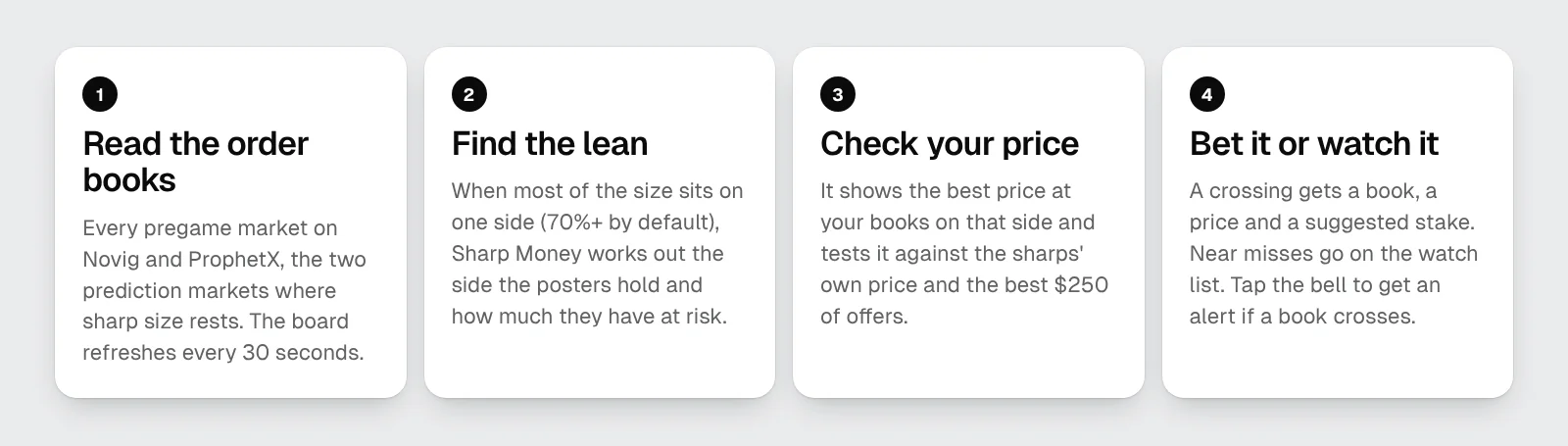
Sharp Money follows the size, then checks your price.
Read a card
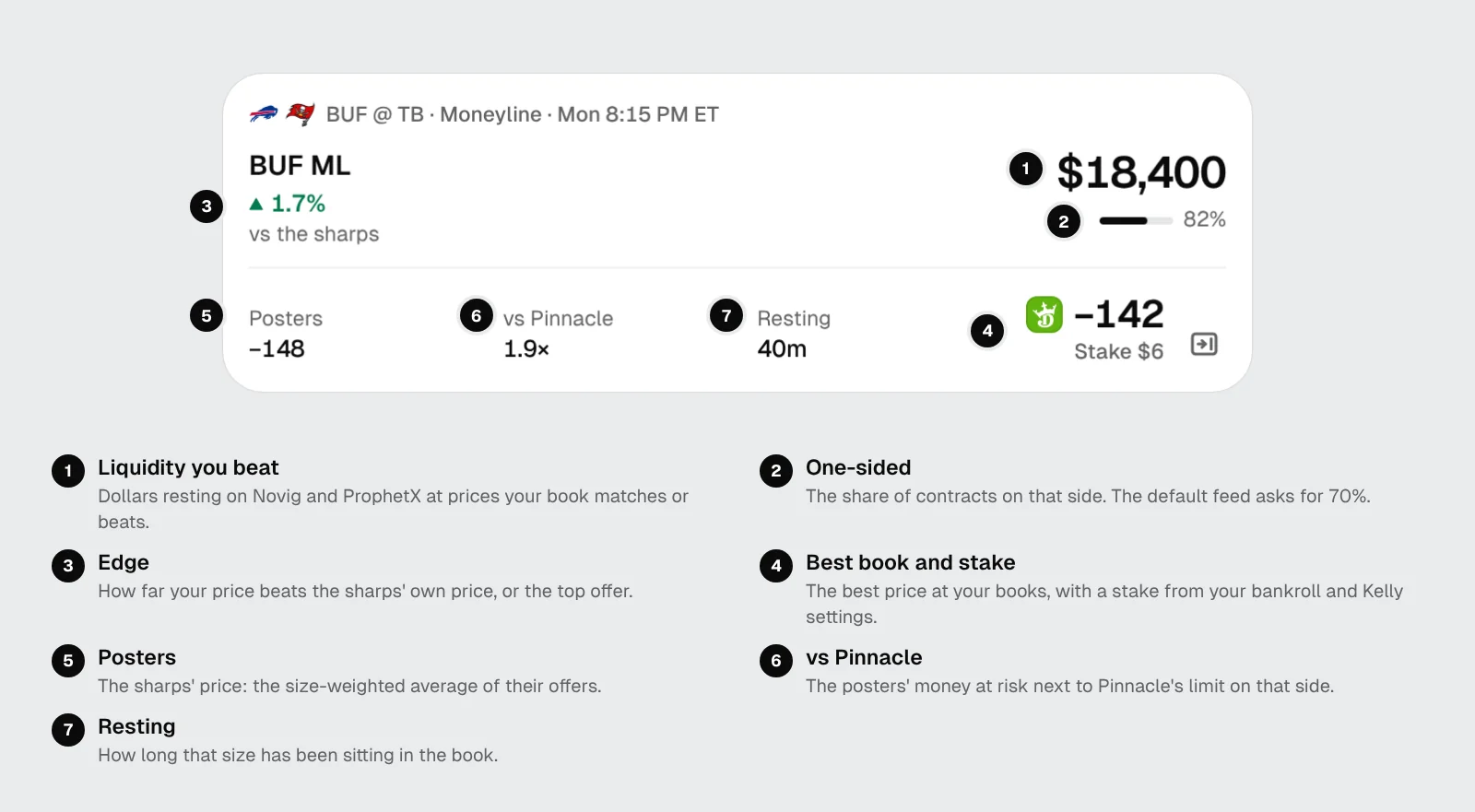
Each card names the game, market and start time on top. Under that, the side and its edge sit on the left, and the liquidity with its one-sided bar sits on the right. Along the bottom are Posters, vs Pinnacle and Resting, then your best book's price, with a suggested stake on a bet tier. Select a card to open its detail panel.
| On the card | Meaning |
|---|---|
| Liquidity you beat | Dollars resting on Novig and ProphetX at prices your book's price matches or beats |
| At the best offer | Shown instead when no book crosses: the dollars at the best prediction market price |
| One-sided | The bar under the liquidity: the share of prediction market contracts on that side |
| Edge | How far your price beats its tier's test. On a Watch row, how far short it is. |
| Best book and stake | Your best sportsbook's price on the side, with a suggested stake on a bet tier |
| Posters | The posters' own price: the size-weighted average of their offers |
| vs Pinnacle | The posters' money at risk as a multiple of Pinnacle's limit, when Pinnacle has the market |
| Resting | How long the orders have rested |
Liquidity is the size behind a price, not a win probability. A bigger number is not stronger evidence on its own. An order book that is close to evenly split says little about direction, which is why the default feed asks for 70% one-sided.
The detail panel adds the posters' money at risk, their own stake on the side they hold. When they hold the favourite it is larger than the liquidity your price crosses (at −156, 1.56 times); on an underdog it is smaller. The panel also has a fair price (Pinnacle's with the vig removed when it has one), Pinnacle's limit, every book's price on the side, both sides of the market, the whole order book, and how the posters' price and the money at risk have moved.
What each tier tests
Every play is placed by comparing your best price with Novig and ProphetX. A tier names the test the price passes. It is not a rating of the bet.
| Tier | The test |
|---|---|
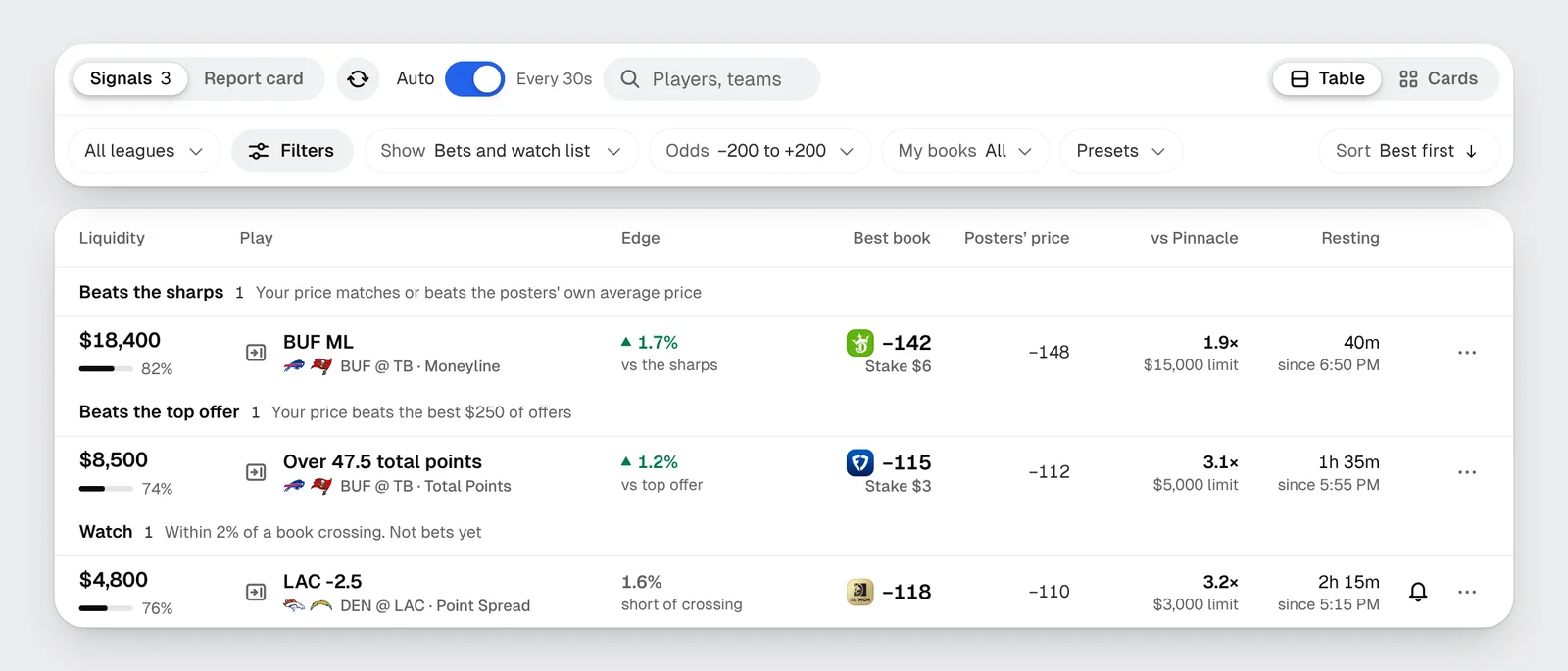
| Beats the sharps | Your price matches or beats the price the posters hold: the size-weighted average of their offers. The strictest test. |
| Beats the top offer | Your price beats the best prediction market offers that add up to $250, but not the posters' average price. |
| Watch | Within 2% of beating the top offer. Not a bet. |
| No cross | Further away than that. It only appears under Every lean. |
For a bet tier, the detail panel shows Tail this with the book, the price and a suggested stake. A Beats the top offer play shows them only when your price is also at or above Pinnacle's fair price. The stake uses the bankroll and Kelly fraction from your Positive EV settings. On Beats the sharps it is a minimum stake: Kelly on how far your price beats the sharps' own price, which is a floor (the true value tends to be higher). On Beats the top offer it is Kelly on the larger of your edge over the top offer and your edge over Pinnacle's fair price. A stake under $0.50 shows as <$1. It is a sizing aid, not an instruction.
Use Show in the filters to choose what the feed lists: Beats the sharps only, All bets, Bets + watch list (the default), or Every lean.
Why the feed is often quiet
Many markets lean hard on Novig and ProphetX at any moment. Few have a sportsbook price that crosses them. When none do, the page says so and lists the near misses on the watch list.
- A crossing typically lasts about half an hour before a book moves or the order is pulled.
- Size tends to build toward game time.
- The default filters ask for $700 at risk, 70% one-sided and odds between −200 and +200.
- Only your books count. A price at a book outside My books doesn't make a play.
A quiet feed is normal. Rather than loosening the filters until something shows up, set an alert and let it tell you when a book crosses.
The watch list and alerts
The watch list sits under the bets and holds markets within 2% of a book crossing. Select the bell on a row to watch that market. A watch sends one alert when that side reaches a bet tier at one of your books, then ends. It also ends when the game starts. Until it ends, each watch counts toward the 20-rule limit in Alerts.
Alert at the top of the page creates a rule from your current filters: leagues, markets, the size and one-sided floors, the odds range and your books. In the editor, choose whether it fires on Beats the sharps only or on both bet tiers. Manage your rules in Alerts, and see how to use tool alerts for the editor.
Watches and alerts go to Discord and your in-app inbox, like the other tool alerts. Choose the channels in the rule editor. Discord DMs need your Discord account linked in Alerts.
Crossings are short, so check the current price when you open an alert.
My books
My books is your account's sportsbook list, the same list Positive EV, Soft Lines, Arbitrage, the odds screen and your alerts use. Changing it here changes it in every tool.
Sharp Money prices a subset of that list: sportsbooks such as DraftKings, FanDuel, BetMGM and Caesars, but not prediction markets, DFS apps or Pinnacle. It shows and edits only the books it covers and leaves the rest of your list alone. If none of your books are covered, the feed stays empty until you add one.
The report card
The Report card tab grades Sharp Money's calls against the closing line, the last price before the game starts. For each tier it shows how often a call's price was better than the close. A coin flip would be 50%. What is CLV? explains why the close is the yardstick.
How grading works:
- Each market side counts once, at its first call.
- The graded price is the best of DraftKings, FanDuel, BetMGM, Caesars, Fanatics and bet365 when the call went out. The set is fixed so the record is the same for everyone, which means it isn't your books. A play's tier on your feed can differ from the tier it was graded at.
- The close is Pinnacle's price with the vig removed, else the average of three or more books, else Novig and ProphetX.
- Only calls in the odds range you pick are included.
- Calls with no closing line are listed separately and left out of the percentage, not dropped.
The best of several books beats the close some of the time on any side, just from shopping for a price. Two checks under each tier show how much of the record that explains:
- Pinnacle's line after the call: on calls Pinnacle priced both when the call went out and at the close, how often its line moved toward the call or away from it, and how much of the CLV came from that move rather than from the price at the call. Shopping for a price only earns the second part.
- Against the other side: the best price among the same books on the side the call didn't take, at the same moment, graded against the same close. The gap between the call and the other side is what the call adds.
The record is early. Calls have been on record since September 2026, and most breakdowns still hold few of them, so a row with fewer than 10 graded calls shows its count but no percentage. Read it as a way to follow how the tiers are doing, not as a track record.
Troubleshooting
- The feed is empty: check that My books includes a book Sharp Money covers, then check the Show and Odds filters.
- Most rows are locked: the full feed is on Pro and above. Other plans see a preview.
- A play disappeared: a book moved, the order was pulled or flipped to the other side, or the game started.
- An alert's play looks different now: prices move within minutes. The alert describes the market as it was when it fired.