 Unjuiced
Positive EV compares an available price with an estimated fair probability derived from a reference market. A positive result means the calculation estimates a positive average return if its probability and execution assumptions are correct.
Set up the scanner
- Select the sport, markets, and sportsbooks you want to inspect.
- Check the comparison or model selection. Its reference books and devig method determine the fair-value estimate.
- Set your minimum EV and other available price/date filters.
- Sort by EV %, Game time, or Kelly stake depending on what you want to review.
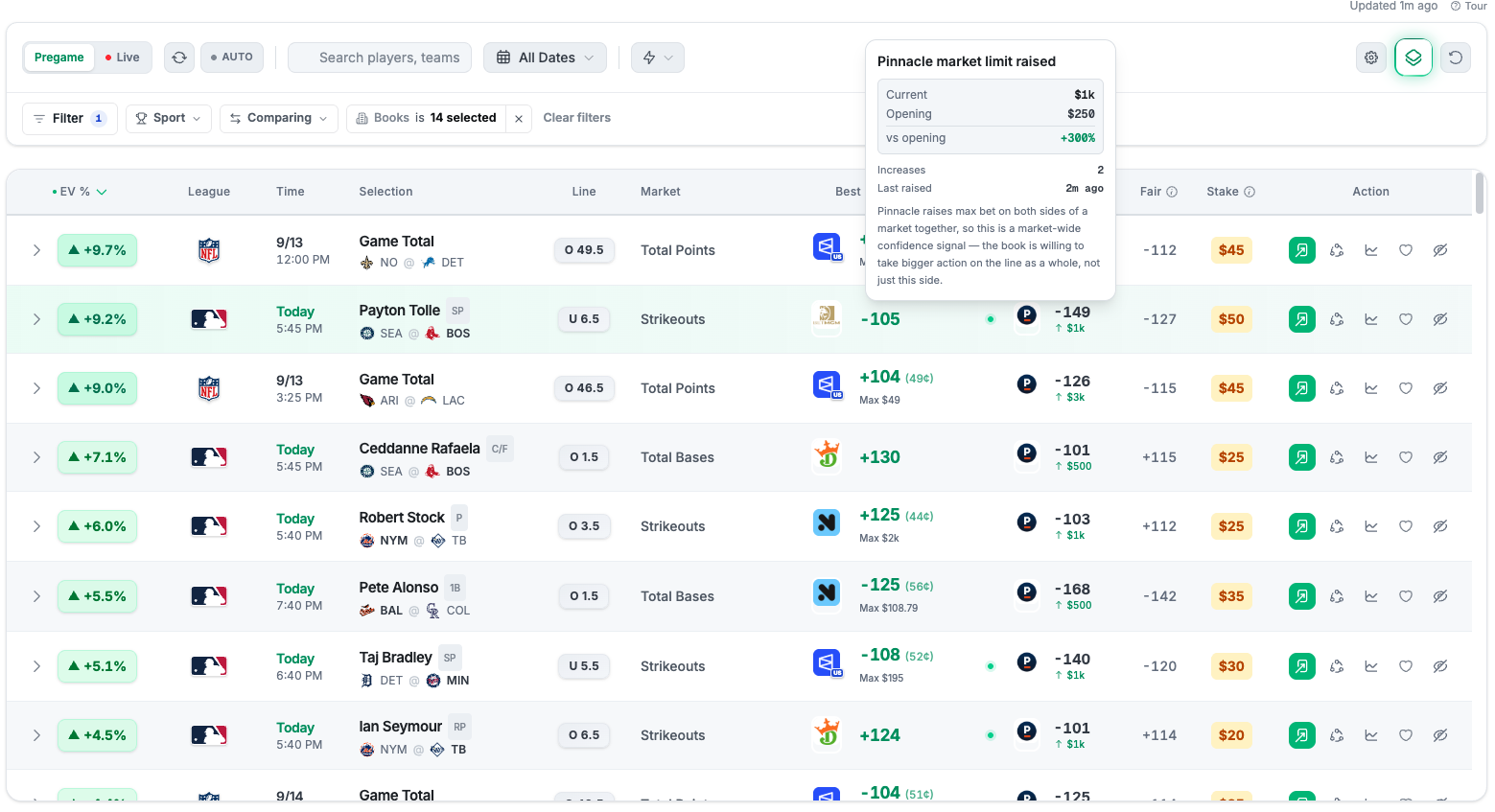
- Expand an opportunity to inspect prices on both sides and compare the available books.
- Confirm the current price at the destination before using the result in a decision or tracking it.
How the calculation works
The scanner uses both sides of a reference market, removes the embedded margin using the selected method, and compares the resulting probability estimate with the offered odds. Removing margin is called devigging. It produces an estimate, not direct knowledge of the true outcome probability.
For decimal odds d and estimated probability p, expected return per dollar is p × d − 1. Multiply by 100 for EV%.
Worked example: a hypothetical market is estimated at a 50% chance and is offered at +110 (decimal 2.10). The estimate is 0.50 × 2.10 − 1 = 0.05, or 5% EV. For a hypothetical $100 stake, that is $5 expected profit across the modeled distribution—not $5 profit on this individual bet. The bet still either wins or loses under its settlement rules.
Understand each output
| Output | Read it as |
|---|---|
| EV% | Estimated return relative to stake at the displayed quote |
| Best Book | The operator and quote highlighted for this selection |
| Sharp / reference | The market used to inform the estimate |
| Fair | The estimated no-margin price, not a price promised by a book |
| Kelly stake | A sizing calculation dependent on probability, price, and saved settings |
| Limit / liquidity | Context for the named market or operator; inspect its label |
EV% is not a win probability. A low-probability outcome can have positive modeled EV at a high enough price; a likely winner can have negative modeled EV at a poor price.
Models and sensitivity
Where custom models are available, check the selected reference books and devig methods before comparing outputs. The same offer can look different under different reference assumptions. Running more models does not turn repeated rows into independent evidence.
Test sensitivity: if a small change in the probability estimate removes the edge, the decision depends heavily on that estimate. In the example above, a 47% estimate at +110 gives approximately −1.3% EV, rather than +5%.
Sizing and tracking
Kelly output is conditional on model accuracy and your saved bankroll/settings. It is not an instruction to use the entire displayed amount. It also does not account for every personal constraint or the combined exposure of correlated selections. Check the inputs rather than treating a large suggested stake as confirmation of quality.
Record your actual accepted price. If the quote moves, recalculate; an old positive result does not carry over automatically. Review closing-price comparisons alongside results and their sample sizes, without treating either as proof of future returns.
Troubleshooting
- An opportunity vanished: either offered odds or reference odds may have moved, or the game/filter eligibility changed.
- No results: check books, markets, odds bounds, minimum EV, and model availability.
- A very large EV%: check the exact line, market rules, and current quote before accepting the estimate.
- A missing limit: unknown size is not unlimited size.
- The book accepts less: use the accepted amount and price; a reference limit does not override your account's limit.