
Open Point correlation. In hockey a goal usually comes with one or two assists, and those points tend to go to the same few players: linemates and the power-play unit. When one of them gets a point, the others often do too. That's correlation, and it's why same-game parlays on linemates can be worth a look.
The sheet has two views, switched at the top left: Correlation shows the links for one game, and Parlays turns the strongest links into ready-made two-leg parlays.
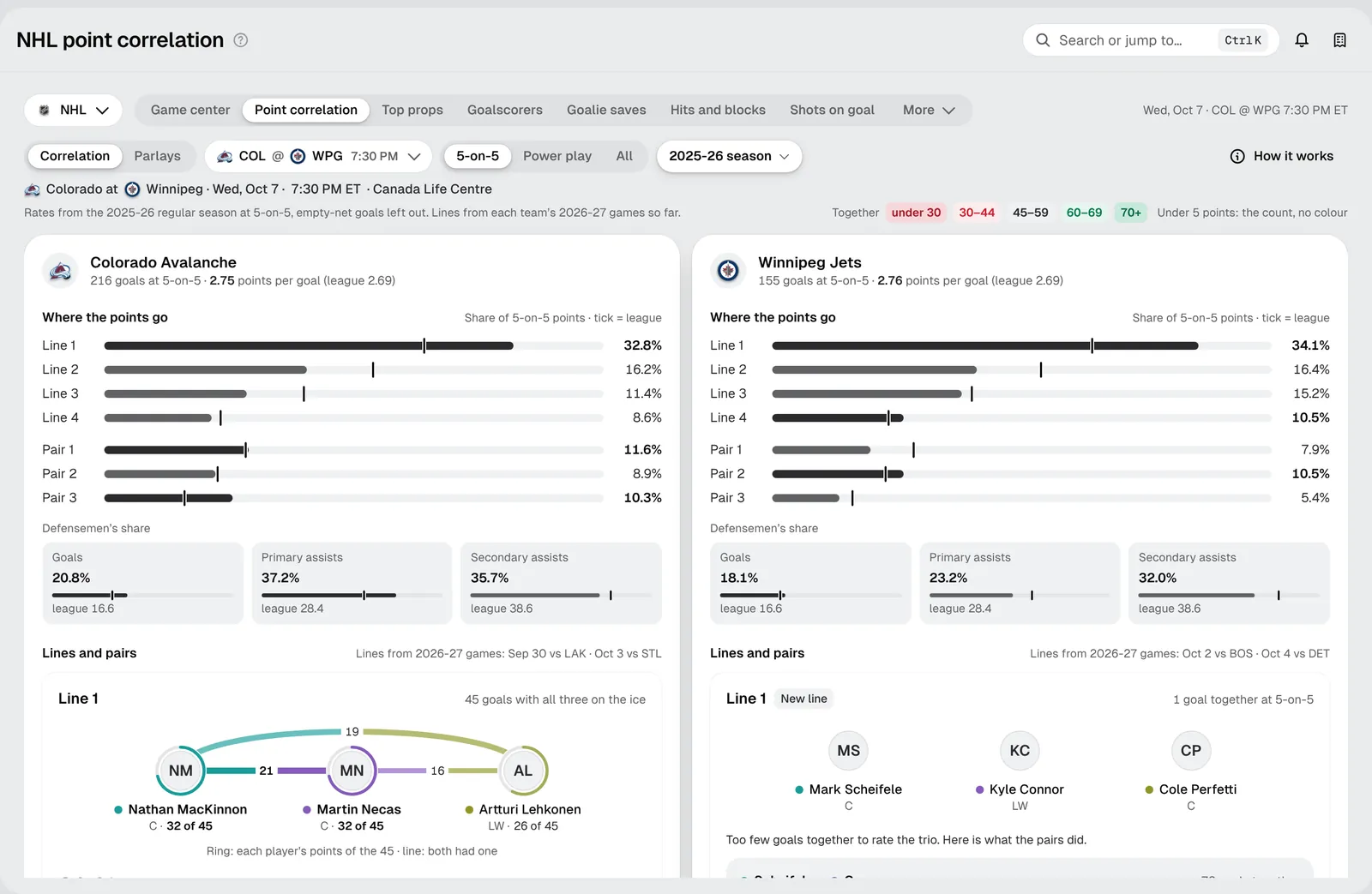
Correlation view
Pick a game from the game pill. Each team gets a card.
Where the points go splits the team's points by line (Line 1–4) and defense pair (Pair 1–3). The tick on each bar is the league average for that slot. A team whose Line 1 bar runs well past the tick leans on its top line.
Defensemen's share shows how much of the team's scoring comes from the blue line, against the league.
Lines and pairs draws each current line as its players:
- The ring around a player fills with the share of the line's goals they had a point on. 32 of 45 means a point on 32 of the 45 goals scored with that line on the ice.
- The line between two players is thicker the more goals they both had a point on.
- 2+ got a point is the share of the line's goals where two or more of its players had a point, next to the league rate for that slot.
A line tagged New line has fewer than 10 goals together. The sheet won't rate a trio from so few goals; it shows what each pair did instead.
The co-point grid
Under each line is a grid. Read it row by column: when the row player has a point on a goal, how often does the column player have one on the same goal? Hover a cell for the counts. Cells with fewer than 5 points print the count without color.
Situations and season
- 5-on-5, Power play or All switches which goals count. Power-play units (PP1) are much more tightly linked than even-strength lines.
- The season pill picks the rates: this season by default, last season one switch away. Early in a season, last season has far more goals behind it.
Colors run from red (under 30% together) to green (70%+). The legend in the top right is the scale.
Parlays view
Switch to Parlays to see two-leg same-game parlays built from each game still to start.
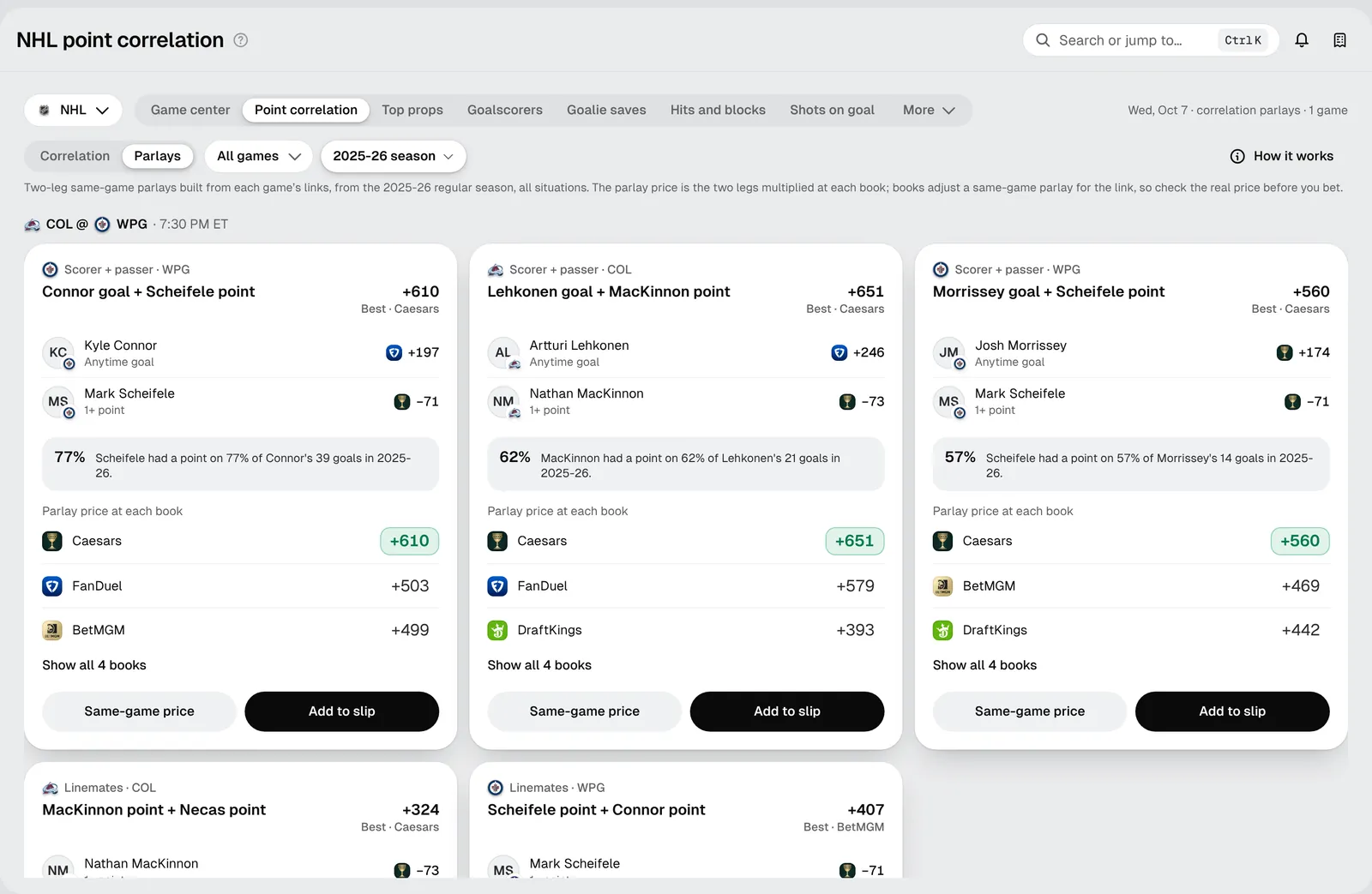
There are two kinds of card:
- Scorer + passer: a player's anytime goal, paired with the teammate who had a point on the biggest share of that player's goals. "Scheifele had a point on 77% of Connor's 39 goals" means that when Connor scored, Scheifele picked up a point 77% of the time.
- Linemates: two linemates both getting 1+ point, for pairs with 20+ games together who score together more often than chance would suggest.
Each card lists both legs with their best prices, then Parlay price at each book: the two legs multiplied together at each book that offers both, best first. Same-game price asks the books for their real same-game parlay price, and Add to slip puts both legs on your betslip.
Tips for newer bettors
- Books know about correlation. A same-game parlay is usually priced below the two legs multiplied together, because the book knows the legs are linked. The multiplied price on a card is an upper bound; press Same-game price before you bet.
- Lines change. The sheet uses each team's lines from this season's games so far. A line blender or an injury can break a pair up. Check the morning skate news.
- Start with PP1. Power-play units are the most reliable links. Switch the situation to Power play to see them.
Troubleshooting
- No parlays for a game: only games still to start get cards, and a pair needs enough history to qualify.
- A line shows only pairs: it's a new line with fewer than 10 goals together.
- The rates look old: check the season pill. Early in the year, last season is often the better sample.